
Marvel's Wonder Man Season 1 (TV Series) | Review
Marvel's most unexpected show strips away explosions to explore what happens when power becomes your biggest liability in Hollywood.
Here's the thing about Marvel's Wonder Man: it's the MCU show nobody expected but might be exactly what the franchise needs right now. Drop the explosions. Forget the world-ending stakes entirely. This eight-episode series asks something simpler and more interesting instead.
If you're tired of CGI battles and multiversal chaos, this one's for you. Wonder Man lands as a character study wrapped in Hollywood satire, anchored by performances that actually earn the runtime. Yahya Abdul-Mateen II and Ben Kingsley don't just share screen time– they elevate it.
This isn't your typical Marvel fare and that's the point. Released under the Marvel Spotlight banner, the show sidesteps grand MCU machinery to focus on something smaller, surprisingly compelling: actual humans beneath capes. Whether you're hardcore completist or someone who bounced, Wonder Man offers a rare entry.
Worth noting upfront: this review digs into what really makes the show work, why it stumbles in places and whether it earns your eight hours. No spoilers for major plot turns but enough honest assessment to help you decide if this one's actually worth the binge or skip entirely.
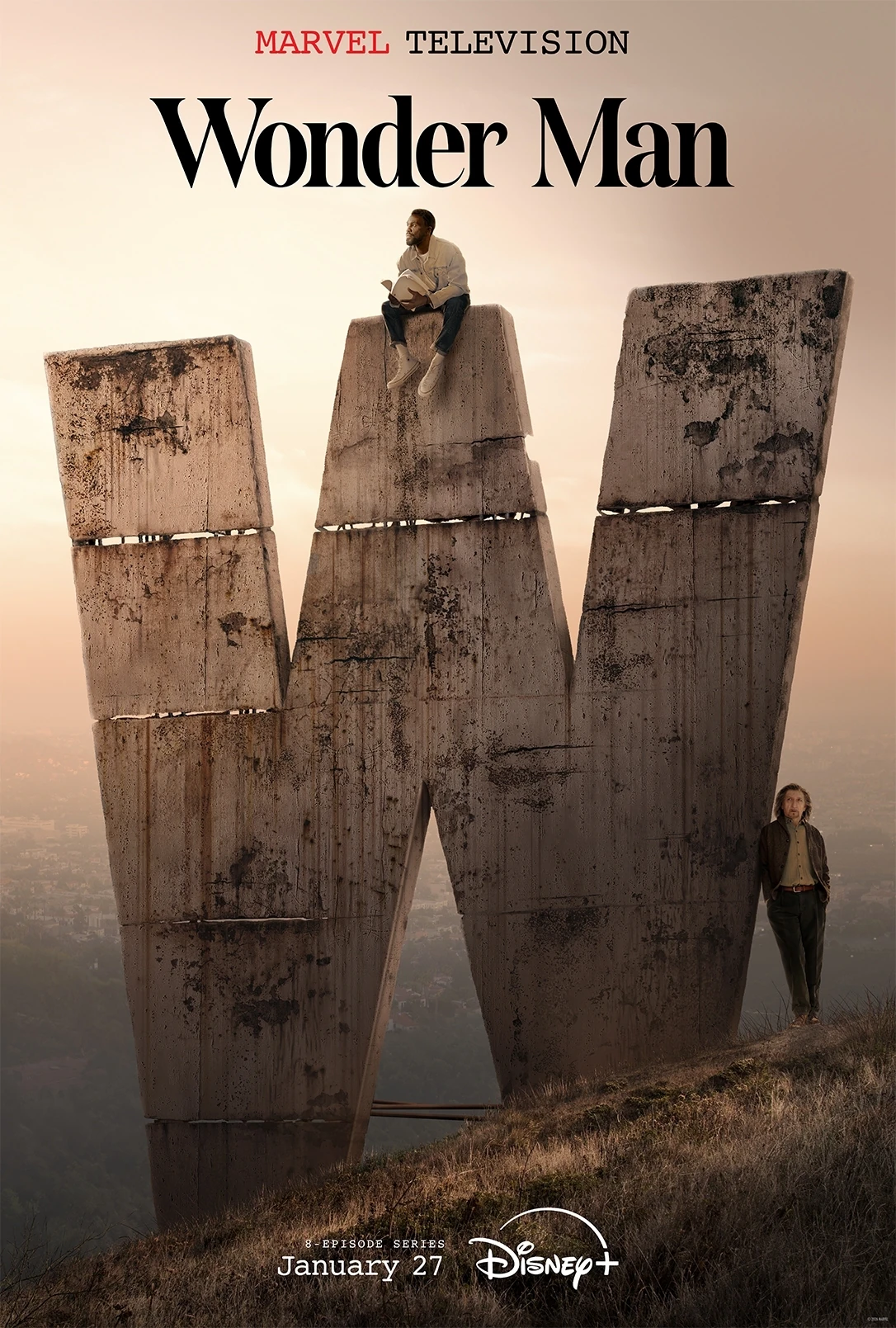 |
| Marvel's Wonder Man Season 1 (TV Series) | Review |
Premise (Spoiler‑Lite)
Simon Williams is a struggling actor in Los Angeles. Not the charming kind of struggle where opportunity lurks around every corner– the real kind, where rent's overdue and callbacks never come. He's talented enough to see what he could be, not quite good enough to get there.
Then he meets Trevor Slattery, the washed-up British actor who once played a fake terrorist in Iron Man 3 and spent time imprisoned by the actual Ten Rings organization. What Simon doesn't know: Trevor's working for the Department of Damage Control, tasked with surveilling him because Simon's hiding a dangerous secret.
He has superpowers– explosive, ionic energy surging when he loses control. Hollywood's Doorman Clause prohibits powered individuals from acting. When legendary director Von Kovak announces a remake of the cult 1980s film Wonder Man, both actors see redemption.
The show operates between buddy comedy and surveillance thriller, dipping into stark pathos when both men are deeply broken people trying to fix themselves through performance. It's messy, intentionally paced, refuses to give you the superhero origin story you expect.
Inspiration from Comics
Wonder Man first appeared in The Avengers #9 back in 1964. In the comics, he's the son of industrialist Sanford Williams, whose company collapses under competition from Stark Industries. Desperate and bitter, Simon agrees to undergo Baron Zemo's ionic ray treatments, gaining superhuman strength and raw durability.
Here's where it gets interesting– Simon can't go through with the betrayal. He turns on Zemo, saves the Avengers, seemingly dies. Except he doesn't. His body transforms into pure ionic energy. He's eventually resurrected by his brother Grim Reaper and becomes a full Avenger.
Disney Plus series flips the entire formula. Instead of industrialist turned actor, this Simon is a struggling actor hiding his powers. Show borrows Hollywood angle but ditches Vision Quest and Force Works storylines completely, making ionic energy a curse rather than heroic asset or his rocky romantic situation with the Scarlet Witch.
The show introduces Doorman Clause, anti-powered law echoing Civil War registration themes. Fire-at-thirteen sparks mutant speculation for X-Men integration. Trevor replaces Beast as his defining friendship, shifting dynamic from superhero camaraderie to mentor surveillance.
Character Portrayal
Yahya Abdul-Mateen II brings a lived-in desperation to Simon Williams that never tips into melodrama. Watch him in audition scenes– there's a hunger that feels real, not performed. He's not playing down-on-his-luck actor; he is one, stripped of vanity and protective irony.
The superpowers complicate everything, as they should. Simon doesn't want them. He can't control them. Every emotional spike risks an explosion, which means every audition becomes a ticking clock. Abdul-Mateen sells the constant vigilance, the way Simon monitors himself like he's defusing a bomb within his nervous system.
Ben Kingsley could've sleepwalked through this. Trevor Slattery is a character he's played three times and it would've been easy to coast on. Instead, he finds new layers. This Trevor is sober, haunted, trying to be better– the cautionary tale knowing what Simon's heading toward.
The real chemistry here is Abdul-Mateen and Kingsley. They're playing opposite energies– Simon's wound-up anxiety versus Trevor's forced Zen calm– and friction generates actual heat. You believe they need each other, believe the friendship matters. When it breaks, you feel it.
Cinematography and Visuals
Wonder Man looks better than it has any right to. Where most Disney Plus Marvel shows default to flat coverage, this one bothers with composition. Cinematographers bring lived-in LA aesthetic avoiding both glamour and grit, landing closer to mumblecore naturalism. Early morning light through cheap apartment blinds, late afternoon haze over traffic tells the story.
The show uses handheld camerawork during audition scenes, keeping movement subtle but present. Creates documentary intimacy pulling you into Simon's headspace. When camera switches to locked-down framing for Trevor's surveillance reports, contrast lands. Color grading skews warm and desaturated, making occasional bursts of Simon's ionic energy hit harder – sudden flares punching through visual restraint.
Where things stumble: show can't decide how to shoot few action beats it includes. There's sequence late in series where Simon's powers manifest during crisis, visual language suddenly shifts to standard MCU coverage – wide shots, rapid cuts, CGI dominance. Competent but generic, completely divorced from style show spent six episodes establishing carefully.
Los Angeles itself becomes character, shot with genuine affection for city's contradictions. Fancy studio lots next to strip mall Thai restaurants. Mansions in hills, apartments in valley. Show captures weird class stratification of entertainment industry LA perfectly. Production designer work is sharp throughout, especially contrast between Simon's cramped apartment and Trevor's eclectic space.
Series Consistency
Here's where Wonder Man runs into trouble. Show was designed for binge release– all eight episodes dropped simultaneously– but doesn't commit to either binge structure or episodic television. Result is something caught between formats, never fully satisfying either approach. Episodes run 25-30 minutes, weirdly truncated for Marvel.
Episodes two through five meander. Character work between Simon and Trevor remains engaging but they're spinning wheels, delaying inevitable confrontations to fill episode count. If released weekly, audience would've revolted by week four. What show does well: gradual accumulation of pressure. Simon's powers are ticking clock, Trevor's betrayal is loaded gun throughout.
Season progression hits wall around episode six, where everything should accelerate toward payoff. Instead, show introduces new complications feeling like retreads of earlier beats. Actual reveal of Trevor's surveillance role doesn't happen until episode seven, criminally late for betrayal audience knew since pilot. Finale rushes to conclude storylines show spent too long delaying.
Binge-ability verdict: plays better in one sitting than weekly but that's damning with faint praise. Structural problems don't disappear; they blur into vague sense of "that was uneven" rather than episode-by-episode frustration. One thing show gets right: friendship between Simon and Trevor is spine and even when plot meanders, that relationship keeps building steadily.
Score and Sound Design
Joel P. West handles composition duties, bringing restraint matching show's grounded approach. Where most MCU projects default to bombastic orchestration, West works in subtle piano themes and understated string arrangements prioritizing mood over heroism. Simon's theme is melancholic, built around minor key progressions suggesting someone always waiting for other shoe to drop.
The score knows when to shut up, which is rarer than it should be. Dialogue scenes play without musical underlining, trusting actors to carry emotional weight without orchestral guidance. When West brings music in, it's purposeful – highlighting moments of genuine connection or foreshadowing betrayals with subtle harmonic shifts registering subconsciously rather than hitting you over head.
Sound design work is sharp during power manifestation sequences. Simon's ionic energy doesn't just glow; it hums, crackles, builds pressure in audio mix before releasing. Sound designers create sonic vocabulary for his abilities feeling physically uncomfortable, like electrical feedback or tinnitus. It's not pleasant, which is point– these powers hurt him completely.
One misstep: finale leans into conventional superhero scoring when Simon finally uses powers intentionally. Suddenly we're getting heroic brass and swelling strings that feel imported from different show entirely. It's not bad composition but it violates aesthetic restraint show worked so hard to establish. West is clearly capable of more interesting choices.
Final Verdict
Marvel's Wonder Man is kind of risk MCU desperately needs to keep taking– character-first storytelling trusting actors and emotional stakes over spectacle. When it works, it's some of best material Marvel Television has produced: funny, surprisingly moving, genuinely interested in what happens when superheroes act like actual humans with real problems.
When it doesn't work, it's because the show can't quite commit to its own premise. The middle episodes meander. The finale rushes. The balance between Hollywood satire and superhero stakes never quite settles into a stable rhythm. You can feel the creative team fighting against expectations, trying to make something different but also hedging their bets with just enough familiar beats to keep the show recognizably Marvel.
Yahya Abdul-Mateen II and Ben Kingsley elevate everything they touch. Their chemistry alone justifies runtime and show is smart enough to build around them rather than burying them under plot machinery. Trevor Slattery's arc from Iron Man 3's most controversial twist to Wonder Man's emotional anchor is one of MCU's stranger redemptions and Kingsley plays every note with full commitment.
Worth watching? Absolutely, especially if you've felt alienated by recent MCU bloat. Worth rewatching? Maybe not - the surprises don't hold up once you know where everything's headed and the pacing issues become more pronounced on repeat viewing. Worth celebrating as a creative direction Marvel should pursue more often? Without question.
Where to Watch:
Marvel's Wonder Man Season 1 streams exclusively on Disney+ in all regions where its officially available. The series is included with a standard Disney+ subscription and is not available on Amazon Prime Video, Hulu (outside bundled Disney+/Hulu regions), Max or Netflix.
-Review.jpg)
-Review.jpg)


-Review.jpg)
-Review.jpg)


-Review.jpg)

 We Stand With Gaza