
Predator: Badlands (2025) | Movie Review
Dan Trachtenberg hands the spotlight to the monster and the Predator franchise finally evolves with Badlands.
One of cinema's most brutal movie franchises just got flipped on its head by director Dan Trachtenberg. After proving himself with Prey, he returns to shatter expectations with a film that dares to ask what happens when you hand the spotlight to the monster itself.
This is not another group of commandos getting picked off one by one in the jungle. Badlands transforms the Yautja from bloodthirsty villain to struggling underdog and the shift challenges every assumption audiences have carried for nearly four decades about what a Predator film should be, can accomplish, or even dare to represent.
This is a character study disguised as a blockbuster, a science fiction Western wrapped in the skin of an action film that refuses to play it safe. The franchise desperately needed this risk. Trachtenberg built something that stands alone while respecting franchise DNA.
 |
| Predator: Badlands (2025) | Movie Review |
Premise (Spoiler-Lite)
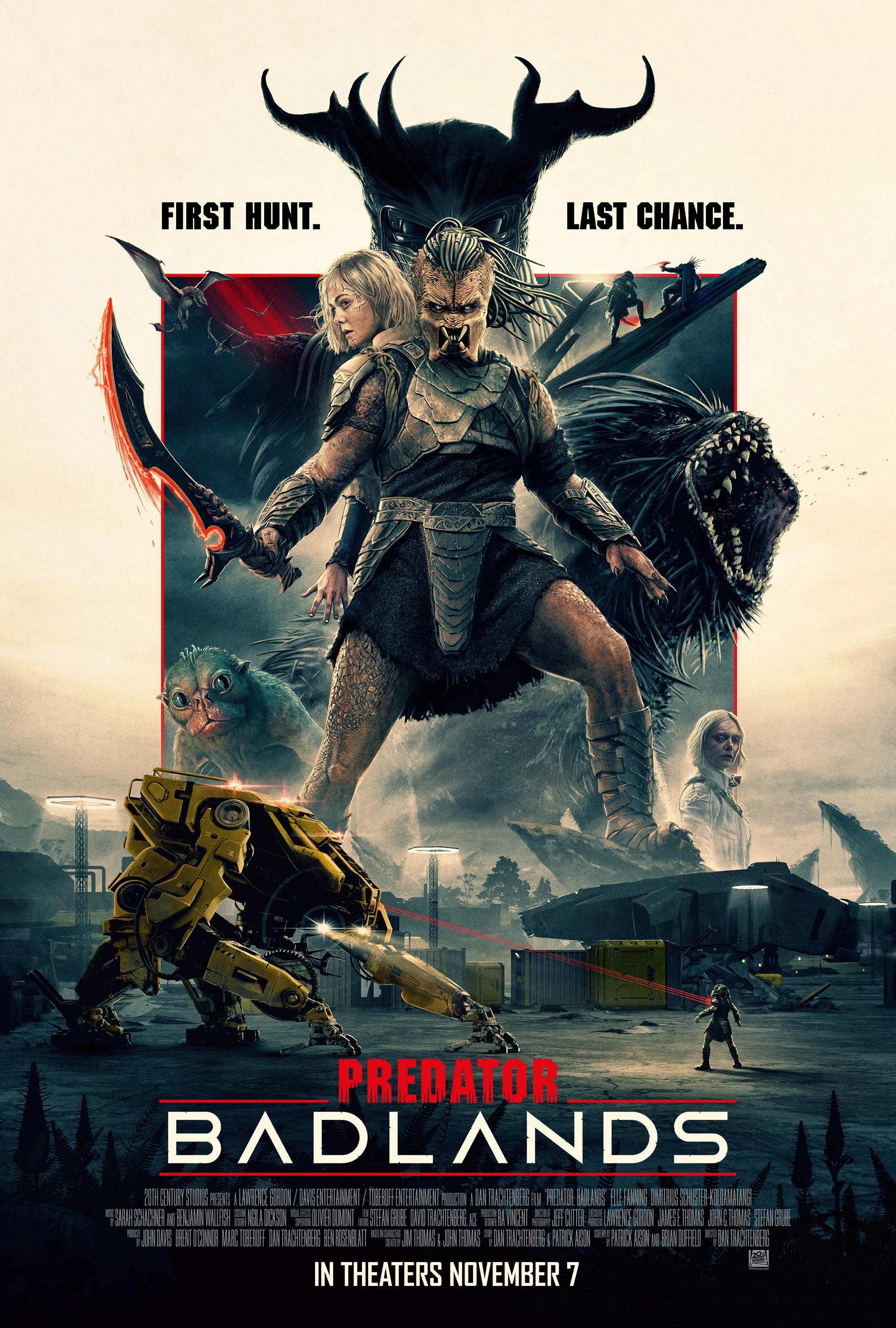
The story centers on Dek, a young Yautja outcast who's basically the runt of his clan, despised for his lack of strength. His father nearly kills him for being weak, branding him unworthy of their bloodline. Rather than accept defeat and a dishonorable death, Dek flees to Genna, known across the galaxy as the planet of death.
His mission: hunt down a legendary creature no Predator has ever defeated and bring its skull home as proof of worth and hard-earned redemption. Everything from the plants to the atmosphere wants him dead on this unforgiving world. Survival alone seems impossible.
On Genna, Dek encounters Thia, a Weyland-Yutani synthetic who's been severed in half and left for scrap by her own corporate masters. She's sarcastic, brutally practical and desperate to find her legs so she can escape this hellscape. They strike an unlikely partnership that changes both of them in ways neither could predict or expect.
The film explores what happens when a culture built on violence and dominance meets the concept of empathy and mutual respect. Dek slowly learns that survival isn't just about being the strongest. Thia learns that tools and logic can't solve everything in the wild.
Inspiration from Comics
Trachtenberg confirmed that Badlands is the first Predator film to draw heavy inspiration from the expanded comic universe. Marvel's Predator: Black, White & Blood and Predator Kills the Marvel Universe both influenced how the film depicts Yautja culture beyond simple hunting.
The film also pulls from Dark Horse classics like Predator: Concrete Jungle, which established the honor code and Predator: Life and Death, which explored clan hierarchies and outcasts. The concept of a runt seeking validation mirrors Predator: Prey to the Heavens and Predator: Hunters, both about warriors seeking redemption.
What works here is restraint. Trachtenberg takes the spirit of those stories and translates them into something cinematic. The comics provide texture without dictating structure or demanding prior knowledge. Longtime readers will catch references but newcomers won't feel lost.
Character Portrayal
Dimitrius Schuster-Koloamatangi delivers a breakthrough performance as Dek, buried under layers of prosthetics and practical effects that could have swallowed him. Every movement feels deliberate. The physicality conveys emotion without dialogue. This is someone fighting to prove he belongs, not just another killing machine.
Elle Fanning plays dual roles as Thia and her twin synthetic sister Tessa. Thia is the heart of the film, sarcastic and sharp-tongued even when dragging herself across hostile terrain. Her chemistry with Dek is bizarre yet compelling through shared survival and mutual respect.
Tessa serves as a foil, colder and more obedient to corporate orders without question. Fanning shifts between them effortlessly, making each feel like a distinct person. The contrast highlights how much choice matters, even for beings designed to follow commands.
Cinematography and Visuals
Genna is a visual marvel that demands to be seen. The cinematography captures sweeping vistas of crimson deserts, bioluminescent jungles and jagged rock formations that stretch toward alien skies. Every frame emphasizes scale, with Dek appearing small against massive landscapes that reinforce his outsider status.
The film uses practical effects wherever possible. Dek's armor, weapons and injuries feel tactile. When he fights, you feel the impact. The CGI integrates well for larger creatures, though some sequences lean too heavily on digital effects during the final confrontation.
Trachtenberg's decision to shoot in IMAX pays off spectacularly for the viewing experience. The thermal vision sequences return with updated clarity. The color grading shifts between cold blues and warm reds depending on emotional tone, making every frame purposeful.
Scene-by-Scene Breakdown
The opening establishes Dek's brutal homeworld within minutes of the cold open. His father's rejection happens fast with no drawn-out exposition or back-story. The crash landing on Genna introduces planetary dangers efficiently through carnivorous plants, poisonous air pockets and shifting terrain that kills without warning or mercy.
The first encounter with Thia is played for dark comedy. She's dragging herself across the ground, cursing the universe loudly, when Dek stumbles upon her. Their negotiation is tense and funny, establishing the dynamic that carries everything forward throughout the film.
The mid-section focuses on varied skirmishes that test Dek's limits and force him to adapt under pressure or die trying on hostile ground. Dek fights hostile wildlife, scavengers and rival Predators sent by his clan. Each fight teaches him something new as Thia's advice changes his tactics from mindless warrior to strategic hunter.
The third act shifts when corporate interference escalates. Tessa arrives with synthetics, complicating everything. The final battle delivers spectacle without abandoning character. The ending suggests growth over glory with a quiet moment that speaks louder than explosions.
Narrative and Pacing
The script moves at a brisk pace that respects your time. At 107 minutes, Badlands never drags or overstays its welcome. Quiet moments between action sequences allow characters to develop naturally. Conversations matter as Thia challenges Dek's worldview without preaching and Dek questions his upbringing without melodrama.
The pacing stumbles slightly when the film introduces too many side threats that don't add much value. A sequence involving rival Predators feels redundant and could have been trimmed without losing impact or narrative momentum. Otherwise, the rhythm holds strong.
What elevates the narrative is thematic consistency that runs through every scene. Every scene reinforces the central question: what defines strength? The film shows you through action rather than spelling it out, making the message land harder through restraint.
Score and Sound Design
Sarah Schachner's score avoids obvious callbacks to Alan Silvestri's original theme, carving its own sonic identity instead with fresh compositions. Percussive elements mirror Yautja culture while strings underscore emotional beats. The music supports without overwhelming, though it lacks a memorable motif that lingers after credits roll.
The sound design excels in ways that elevate the experience. The Predator's signature clicking mandibles return sharper and more varied. Weapon effects hit with weight, especially the plasma caster in IMAX. The planet hums with ambient noise that keeps tension high.
Silence is used strategically to amplify sudden violence and make every strike earned. When action explodes, it hits harder because the film knows when to hold back and let moments breathe. The audio mix balances dialogue, effects and score without muddying any element.
Final Verdict
Predator: Badlands earns its place as one of the franchise's boldest entries in decades, willing to take real risks with its core formula. Trachtenberg's gamble on centering a Predator protagonist pays off because character matters more than carnage in the end. Dek's journey resonates through genuine emotional growth that feels earned.
This is a story about finding worth beyond violence, about choosing connection over conquest. For a franchise built on brutality, that's revolutionary. The action delivers, the world-building expands significantly and the performances surprise in ways you won't expect.
Is it perfect? No. The score could be stronger, some CGI feels overused and certain sequences drag more than they should in the second act. But these flaws don't sink the overall experience or diminish what works here. Badlands proves the franchise still has fresh stories worth telling when filmmakers take risks and trust their vision.
If you've been waiting for evolution beyond survival horror and predictable franchise formulas, this is it. Badlands respects its roots while planting seeds for something genuinely different that the series hasn't explored. Just don't expect Arnold Schwarzenegger to anchor it in nostalgia.
Where to Watch:
Predator: Badlands (2025) is streaming exclusively on Hulu in U.S. and Disney+ internationally. It's also available for digital rental and purchase through Amazon Prime Video, Apple TV, Google Play Movies and YouTube. A 4K UHD Blu-ray with bonus featurettes and behind-the-scenes content is expected later this year for collectors.
-Review.jpg)

-Review.jpg)
-Review.jpg)
-Review.jpg)
-Review.jpg)
-Review.jpg)

-Review.jpg)
-Review.jpg)

 We Stand With Gaza